

Driveways are exposed to regular rainfall, vehicle movement, dirt, leaves, and surface runoff. Without suitable drainage, water can collect near garages, entrances, walls, or low points, increasing the risk of surface damage and inconvenient pooling.
Linear drainage channels are commonly used to collect water across the width or edge of a driveway and direct it toward an appropriate outlet. Selecting the right system requires more than choosing a channel that fits the available space. Load rating, material, flow capacity, grate design, installation conditions, and maintenance access all influence performance.
If you are considering how to choose linear drainage channels for driveways, the following factors can help you make a practical and informed decision.
Assess the Driveway and Drainage Requirements
The first step is to understand how water currently moves across the driveway.
Look for areas where rainwater naturally collects, including garage entrances, sloped sections, driveway gates, and points where the driveway meets a road or pathway. These locations can indicate where a drainage channel may be most effective.
The total surface area of the driveway should also be considered. A larger paved area can generate more runoff during heavy rainfall, which may require a channel with greater drainage capacity.
Consider the Driveway Slope
Driveway slope affects both the location and size of the drainage channel.
On a sloped driveway, a channel positioned across the lowest point can help intercept surface water before it reaches a garage or building entrance. On flatter surfaces, drainage may need to be planned around several low areas.
The surrounding landscape should also be reviewed because water from gardens, roofs, paths, or neighbouring paved surfaces may contribute additional runoff.
Choose the Correct Load Class
One of the most important considerations is the amount of weight the drainage system will need to support.
A channel installed in a pedestrian area has different requirements from one that regularly supports cars, delivery vehicles, vans, or heavier vehicles.
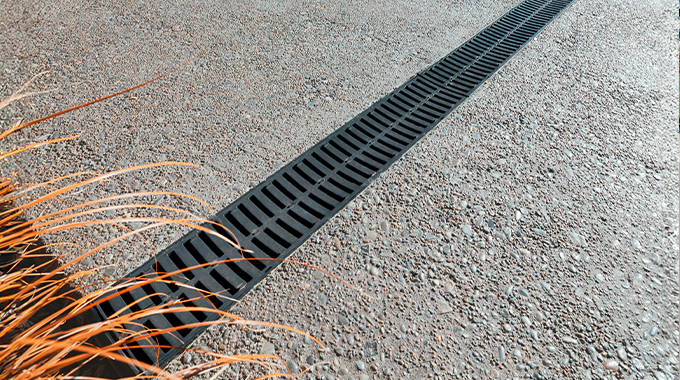
For a residential driveway, the drainage channel and grate should be rated for vehicle traffic. Always check the manufacturer's load classification before purchase.
Choosing a system with an unsuitable load rating can lead to cracked channels, damaged grates, movement, or premature failure.
Consider Future Vehicle Use
Current vehicle use is important, but future requirements should also be considered.
For example, a household that currently uses small passenger cars may later need to accommodate a larger SUV, service vehicle, or delivery van. Selecting a drainage system with an appropriate safety margin can reduce the need for replacement later.
Compare Drainage Channel Materials
Linear drainage channels are available in several materials, each with different characteristics.
Polymer concrete, traditional concrete, plastic, and composite materials are commonly used for channel bodies. Grates may be manufactured from galvanised steel, stainless steel, cast iron, plastic, or composite materials.
Plastic channels can be lightweight and straightforward to handle during installation. Polymer concrete systems may provide greater rigidity and durability for more demanding applications.
The best option depends on the expected traffic, installation method, drainage environment, and budget.
Select a Suitable Grate Material
The grate is the visible part of the drainage system and receives direct contact from vehicle tyres.
For this reason, grate strength should be considered carefully.
Galvanised steel is commonly used in residential applications, while stainless steel may be preferred where corrosion resistance and appearance are important. Cast iron is often selected where higher load resistance is required.
The grate design should also allow water to enter efficiently without creating unnecessarily large openings.
Check the Channel Flow Capacity
Understanding How to Choose Linear Drainage Channels for Driveways also requires attention to water flow capacity.
The channel must be able to collect and transport expected rainfall without overflowing. Capacity is influenced by channel width, depth, internal shape, slope, outlet size, and the number of drainage points.
A wider or deeper channel generally provides greater capacity, but larger is not automatically better. The drainage system should be selected according to the actual runoff requirements of the driveway.
For larger paved areas or locations that experience heavy rainfall, professional drainage calculations may be appropriate.
Consider Channel Width and Depth
Channel dimensions affect installation as well as performance.
Narrow channels can work well in smaller residential areas where runoff is moderate. Deeper channels can hold and transport more water but may require greater excavation.
Before choosing a system, check the available installation depth, existing underground services, finished driveway level, and location of the drainage outlet.
The top of the grate should generally sit level with or slightly below the surrounding surface so that water can enter easily.
Plan the Drainage Outlet
A linear channel only works effectively when collected water has somewhere suitable to go.
Possible outlets may include an approved stormwater system, soakaway, drainage pipe, or another permitted discharge point.
The outlet should be positioned so that water can move freely away from the channel. Poor outlet design can cause water to remain inside the drainage system or back up during heavy rain.
Local drainage regulations should always be checked before directing surface water into an existing system.
Think About Installation Requirements
Correct installation is essential for the long-term performance of a driveway drainage channel.
The channel normally requires a stable base and appropriate side support to prevent movement under vehicle loads. The manufacturer's installation guidance should be followed regarding excavation depth, concrete surround, jointing, outlet connections, and grate positioning.
Channels must also remain properly aligned. Uneven sections can restrict flow or create areas where debris collects.
Position the Channel Carefully
Common installation locations include:
-
Across the entrance to a garage
-
At the bottom of a sloped driveway
-
Near the boundary between driveway and road
-
Along the edge of a paved area
-
Across sections where surface water regularly pools
Placement should follow the natural direction of water flow whenever possible.
Consider Cleaning and Maintenance
Drainage channels collect more than water. Leaves, soil, small stones, sand, and other debris can enter through the grate and gradually reduce flow.
Choose a system with removable grates so the channel can be inspected and cleaned when required.
Some systems also include access points or sediment collection features that make routine maintenance easier.
Regular cleaning is particularly important during autumn, periods of heavy rainfall, or in driveways surrounded by trees and landscaping.
Conclusion
Choosing a suitable linear drainage channel requires careful consideration of the driveway's slope, surface area, vehicle loads, rainfall exposure, channel capacity, grate material, and available outlet.
When deciding how to choose linear drainage channels for driveways, focus on selecting a system that can safely support expected traffic while managing the amount of surface water generated by the site.
A properly sized and correctly installed drainage channel can help reduce standing water, direct runoff away from vulnerable areas, and support the long-term condition of the driveway. Reviewing product load ratings, drainage capacity, installation instructions, and maintenance requirements before purchase can help ensure the system is appropriate for the intended application.
